“All was forgiven without a word” Oasis: Don’t Look Back in Anger
Written by Mia Samson
Credit: Oasis: Don’t Look Back in Anger
Something about the scale of Oasis’ return feels almost ridiculous. What began with two brothers who could barely stand to be in the same room became 41 enormous concerts across five continents, thousands upon thousands of bucket hats, and an entire generation suddenly remembering exactly why they fell in love with music in the first place.
Oasis: Don’t Look Back in Anger could have easily been nothing more than a two-hour victory lap. Instead, it becomes beautiful: a story about forgiveness, friendship, community and the ability that music has to make people forget, for a few hours, everything that usually keeps us apart.
Of course, it is still Oasis.
Liam Gallagher is Liam Gallagher. The tension is at its peak when he arrives days late to rehearsal with the rest of the band waiting. He arrives, complains about the drum kit giving him “the hump” and wanders off again, seemingly completely unaware that the entire world is on the edge of their seats to see whether he and Noel will make it through the tour. Noel, meanwhile, is his usual dry, cynical self, but there is something noticeably softer about him. The brothers are older now. Maybe age has finally done what years of arguments couldn't.
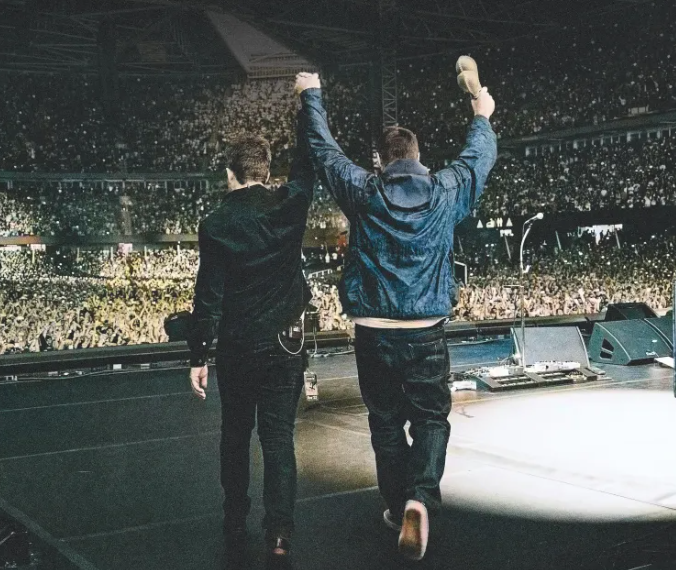
Watching the first Cardiff show, you can feel that uncertainty hanging over everything. After 15 years apart, there is every possibility that this could all fall apart before it has even begun. Then Liam reaches for Noel's hand as they walk onto the stage.
It is spontaneous. It is tiny. And somehow it feels enormous.
Because Don’t Look Back in Anger is ultimately less interested in whether Oasis can still sell out a stadium—we already know they can—and much more interested in what their return means to the people filling those stadiums.
From Cardiff to Manchester, London and then across the world, the documentary repeatedly leaves the Gallaghers behind to listen to the fans. Mothers, sons, old friends, young fans who weren't even alive when Definitely Maybe was released. Their stories are sometimes funny, sometimes heartbreaking, but all say essentially the same thing: Oasis became part of people's lives in a way that goes far beyond music.
And perhaps that is why the reunion feels so significant now.
We live in a world that seems increasingly determined to divide itself. Politics, social media, algorithms and an endless stream of things to argue about have made being angry almost effortless. Yet for a few hours, tens of thousands of people can stand shoulder-to-shoulder singing the same words, regardless of where they come from or what they believe.
There is something very inherently working-class about that sense of togetherness too. Oasis have never really belonged solely to the Gallagher brothers. They came from Manchester, from an ordinary background, and somehow became one of the biggest bands in the world without losing that feeling that they were still, in some way, ours.
The documentary captures that beautifully.
But the moment that struck a chord the most wasn't really about Oasis at all.
It was Mani.
The tribute to Gary ‘Mani’ Mounfield, the Stone Roses bassist, and later Primal Scream, as well as a friend of the band, arrives almost unexpectedly. This isn't simply a passing acknowledgement of a musician who has died. The documentary takes time to show what he actually meant to them — a friend, an icon, an influence and a person whose presence was more important than the music he made.
It is one of the rare moments where the bravado falls away completely.
Noel reflects on Mani's death and what it made him think about his own mortality. Suddenly, this enormous reunion—the lights, the stadiums, the screaming crowds—feels strangely temporary. People grow older. Friends die. Bands split. Brothers fall out.
And yet the songs remain.
That, more than anything, is what Don’t Look Back in Anger understands.
Noel Gallagher may have written the songs, but they no longer completely belong to him or the band. Liam himself speaks about allowing the music to be the superhero, and watching thousands of people attach their own memories, grief, friendships and stories to these songs makes that feel completely true.
Perhaps that is why the documentary is so emotional. It isn't really asking us to care whether Oasis are still the greatest band in Britain. It is asking us to remember why music mattered so much in the first place.
For all the jokes, the bucket hats, Liam's ridiculous one-liners and Noel's perfectly timed cynicism, there is a deep sincerity underneath it all.
Oasis brought people together.
They brought two brothers back together. They brought old friends back together. They brought generations together. And for a few hours, they brought entire stadiums of strangers together.
In a world that seems increasingly intent on reminding us how different we all are, perhaps there is something rather beautiful about thousands of people screaming the same song at the top of their lungs.
Maybe that is what Oasis have always been about.
Not looking back in anger, but looking around and realising that, for once, we're all in the same room.