From independent to international: Why the music industry cannot lose grassroots venues
Written by Molly McGee
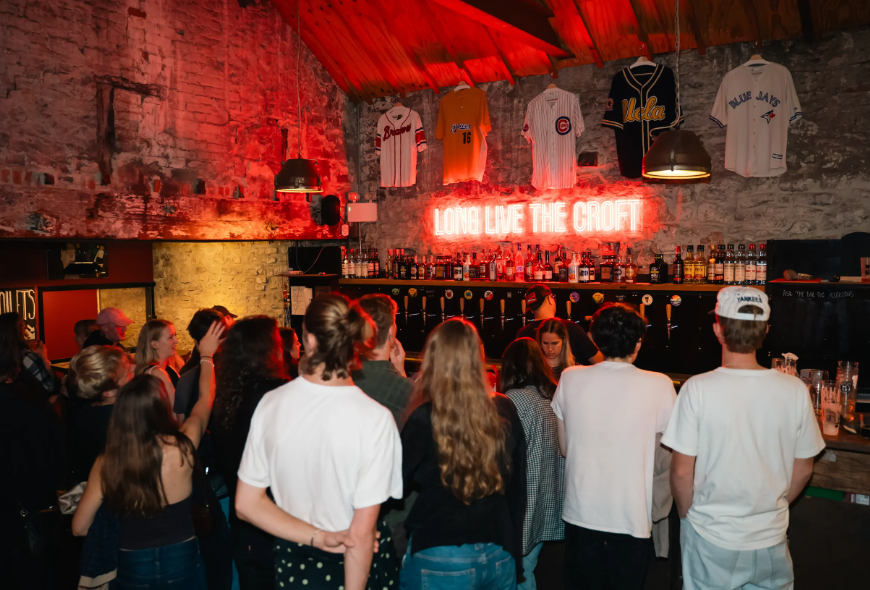
The Croft, Bristol | Credit: www.thecroftbristol.co.uk
Grassroots music venues (GMVs) are small live performance spaces which are significant stepping stones in a musician’s career.
While easy to overlook, GMVs are the epicentres of emerging talent. Many household names such as The Beatles, Coldplay and Ed Sheeran had similarly humble beginnings, playing intimate shows before selling out stadiums.
While the crowds may be minimal, the opportunities are huge. They offer aspiring musicians a chance to build perseverance, refining their identity to an audience of curious listeners gracious enough to give their music a chance.
As well, performing in these small capacity venues gives artists a chance to prove their commitment to music, working hard to foster fan-artist relationships as well as industry connections.
Showcasing up-and-coming talent rather than mainstream artists, these venues ensure that live music remains accessible through their low-ticket prices.
As well, their presence within smaller towns means fans are not faced with the financial burden that comes with accessing arenas and stadiums in cities.
GMVs also create jobs for local people and encourage spending in local businesses, boosting community morale.
However, these venues are becoming scarce as they struggle to survive amidst today’s struggling economic climate.
Their centrality to so many livelihoods make the effects of these closures detrimental. They are essential in driving innovation and embracing musical diversity, allowing people access to discover new styles and genres that they would not usually be interested in.
The Guardian reports that one third of grassroots venues are operating at a loss, with 125 venues being forced to close in 2023 alone. That means these spaces were disappearing at a rate of around two per week, leaving behind a plethora of cultural and economic concerns in its aftermath.
A particularly troubling statistic is that around 93% of UK grassroots music venues have got a private landlord, reports Jay Taylor from Music Venue Trust, a charity committed to preserving and improving GMVs.
This generates a sense of despair when looking ahead to the future of grassroots venues. It is difficult to imagine an outcome where the financially and creatively motivated business objectives can co-exist.
Spaces which were initially created to champion artists are becoming stagnant under the pressure of rising costs, forcing them to disappear from the live music scene entirely.
However, hope is not entirely lost. Several campaigns, such as Independent Venue Week (IVW) and the Own Our Venues scheme have been set up to ensure that grassroots venues remain pillars of local communities and the music industry itself.
IVW was first launched in 2014 by Sybil Bell, highlighting how important the existence of grassroots music venues is.
Partnered with BBC 6 Music and Arts Council England, as well as several celebrity ambassadors, IVW promotes the mantra “Purpose over profit.”. This celebrates the work of these venues in giving back to both creatives and fans, enriching cultural ecosystems rather than operating for financial gain.
Bell referred to GMV’s as “a really important part of British culture”, reinforcing their centrality to the formation of both individual and geographical identities.
Following on from this, in 2022 the Own Our Venues scheme was launched by Music Venue Trust.
Since then, saving GMVs has transformed from ambition to reality with 10 venues being secured since 2023, all because of collective responsibility and crowdfunding.
To date, around £4m has been raised from passionate music fans. This has been used to save iconic venues including The Croft in Bristol and The Joiners in Southampton, where artists such as Arctic Monkeys, Ed Sheeran, Coldplay and Oasis played in their early careers.
These donations have been matched with a £500k investment from Arts Council England, contributing to the security of a more stable and sustainable musical future.
Positively, 2025 saw a 13% increase in people attending grassroots gigs, with 21 million fans attending these shows and the rate of venue decline slowing to its lowest level since 2018 at 1.2%.
The £1 levy was also introduced as a method of combating the decline. In 2025, the LIVE Trust introduced a voluntary £1 contribution on tickets from stadium and arena shows with over 5,000 capacity.
While this is currently not statutory, and many of the biggest promoters such as Live Nation remain absent from the scheme, this initiative is a promising start at improving the hardships being endured by GMVs.
Artists including Pulp, Wolf Alice and Enter Shikari have adopted the scheme, with Coldplay also giving 10% of the proceeds from their 2025 tour to the fund.
This demonstrates that any donation, no matter the size, contributes to a changeable difference to grassroots venues and the music industry.
It also signifies the undeniable ability of collective action to determine the future of live music, showing that music fans can tip the scales in favour of a more optimistic outcome for their local venues and upcoming artists.