“The dance floor is dead”: Charli xcx’s Music, Fashion, Film
Written by Emily Gibbs
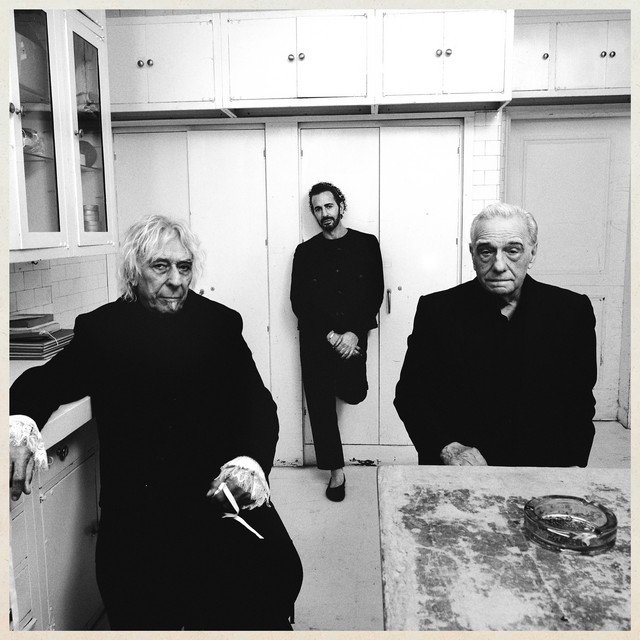
Music, Fashion, Film by Chari xcx album cover
Charli xcx’s Music, Fashion, Film represents a distinct departure from the previous BRAT era. Instead of the dance-pop and rave styles of BRAT, Charli’s new album leans into acoustic and rock production, with the use of heavy drums and guitar.
The album cover for Music, Fashion, Film features three iconic figures that represent each art form respectively: John Cale, Marc Jacobs, and Martin Scorsese. Their faces are being used as figureheads for her music, thus cementing Charli’s status within the artistic world.
‘Rock Music’ was released as the first single from the album. Many fans (myself included) were excited about the possibility of Charli embracing the rock genre, but it is not as obviously ‘rock’ as many fans expected. The lyrics of ‘Rock Music’ discuss the need to move to a new genre as “the dance floor is dead”, hence representing a departure from the dance tracks of BRAT. Much of the album comments on the necessity of constant reinvention, as Charli feels she cannot repeat the previous pop sound and must instead find a new genre.
The album’s themes are addressed in ‘SS26’. The title echoes that of a fashion collection. The lyrics are resoundingly pessimistic, with the chorus lamenting “nothing’s gonna save us, not music, fashion or film”. This line references back to the album title and suggests that the album’s message is the fleeting and ultimately futile nature of art, particularly in the face of global issues. There is an apparent contradiction between Charli’s evident love of creating art throughout the album, and her view of its futility.
One of my personal favourites, ‘Camera’, discusses two aspects of the album title: music and film. Charli has spoken candidly about her desire to be more involved in the acting world and mentions here her hesitation to do so “when I’m turning 34”. The repeated refrain of “it makes me feel” in the chorus implies that Charli becomes increasingly self-aware through the process of acting, as if acting as someone else contradictorily makes her feel more herself.
‘Yeah’ is one of the best examples of the lyrical style of the album, which is basically as few lyrics as possible. Charli repeats the line “I don’t wanna”, before she shifts to “wait, now I wanna feel it”. The song then explodes into a loud melody that demonstrates the experimental tone of the album.
Music, Fashion, Film has a heavily satirical tone and refuses to take itself too seriously. This is most strongly demonstrated in the catchy ‘Wink, Wink’, which intentionally adds doubt to the honesty of the lyrics in the chorus by including confessional lines followed by “wink, wink”. This results in a playful subversion of truth. The track, like many others, uses a spoken word technique as the lyrics are more spoken than sung, particularly in the verses, increasing the confessional aspect of the lyrics.
Overall, Music, Fashion, Film offers an unconventional and experimental sound. It is perhapsan unexpected venture for fans of Charli’s previous works, but if you can give it a chance (and at least a few listens), then you might find yourself surprised by how much Music, Fashion, Film grows on you.