How MINX’s failed debut became Dreamcatcher’s greatest advantage
Written by Matilia Trammell
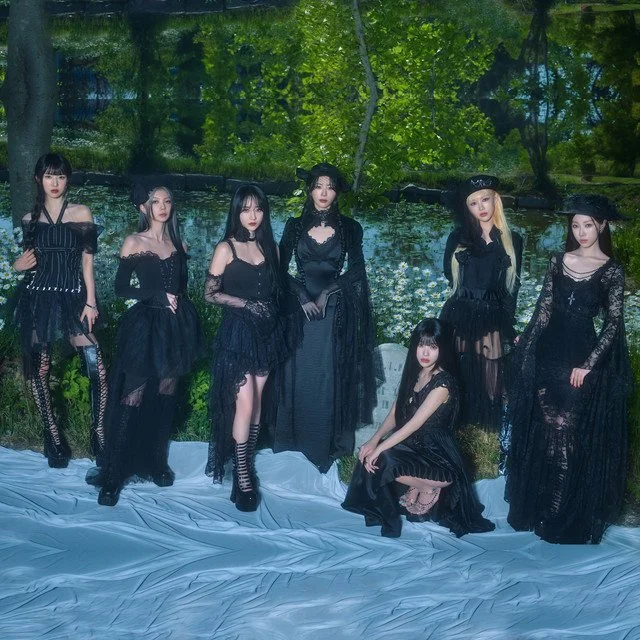
Dreamcatcher via Spotify
Dreamcatcher probably would not exist in the form listeners know today if MINX had worked.
Years before the sinister imagery, pounding guitars and elaborate horror storylines became synonymous with Dreamcatcher, five of its members had already debuted together under Happyface Entertainment. JiU, SuA, Siyeon, Yoohyeon and Dami were first known as MINX, a group almost unrecognisable from the one they would eventually become.
MINX debuted with their single ‘Why Did You Come To My Home?’ in 2014 before returning the following year with Love Shake, complete with the kind of bright, bubbly summer concept that could be found everywhere in mid-2010s K-pop. It was colourful, cheerful and beyond far removed from the sound that would later make the members stand out.
It was also not working.
MINX weren’t doing anything particularly inexplicable for a girl group in 2014 and 2015. Cute, lively and innocent concepts were common, and following a formula that audiences had already shown an appetite for made commercial sense. The problem was that plenty of other groups had reached the exact same conclusion.
Happyface Entertainment CEO Lee Joo Won later described the girl-group market MINX entered as a “red ocean” - an overcrowded space where competition had become fierce. MINX had followed the prevailing trend, but the group had little room to distinguish itself within it.
So, lost in the shuffle of every other group doing similar concepts, MINX struggled to gain traction and disappeared from the release calendar completely after Love Shake. But Happyface eventually made an unusual choice: Rather than deciding that the five members themselves had failed and shelving them completely, the company reconsidered what the group could actually be.
The company didn’t appear to view the members’ abilities as the problem. Lee explained that the five had trained for a long time and received praise after debuting, so it wasn’t them that the company had lost faith in. Instead, what Happyface lost faith in was the strategy surrounding them.
Continuing down the same path would have meant hoping MINX somehow became more visible while competing against groups offering similar concepts, often with larger companies, existing fanbases or greater promotional resources behind them.
So Happyface stopped trying to make them fit in with the crowd.
And that saved Dreamcatcher before Dreamcatcher even existed.
More than a year passed without another MINX release, but then, there came a reset. The MINX girls were starting again without completely starting over. The five original members remained, with new members Handong and Gahyeon joining them. Thus, MINX became a seven-member group with a new name: Dreamcatcher.
Almost everything around those five familiar members changed as Happyface settled on a darker visual identity, horror-based storytelling and a rock and metal-influenced sound that was unusual among K-pop girl groups at the time.
Lee later described the purpose behind Dreamcatcher in remarkably simple terms: doing “what others don’t do”
That approach could easily have gone wrong.
The safe response to an unsuccessful group might have been to chase whatever trend had replaced the last one, or scrap the project altogether and debut new trainees, as is the norm. Yet instead, Happyface had bigger, historically rare plans: the company decided to reinvent the wheel and give people a stronger reason for fans to remember the MINX girls.
Dreamcatcher officially debuted in January 2017 with ‘Chase Me’, and subtlety was nowhere to be found within it. The music video abandoned MINX’s sunshiney concept almost entirely. In it, seven women haunt a man through an eerie hotel while the track tears forward on aggressive drums and distorted guitars.
Their debut single album was literally called Nightmare.
And with that, Dreamcatcher had gone from competing within one of K-pop’s most familiar lanes to occupying one with substantially less traffic.
Importantly, the reinvention was deeper than merely putting the members in darker clothes and calling it a day. The rock foundation they built later became one of the most identifiable parts of their music, while the nightmare concept developed into ongoing storylines that would span releases.
And even the qualities that might have limited Dreamcatcher’s mainstream appeal became useful. Rock and metal were hardly obvious foundations for a Korean girl group in 2017, but they offered access to listeners whose tastes extended beyond conventional K-pop, attracting a new audience that even other, more successful groups couldn’t grab.
Their sound also bore similarities to Japanese rock, particularly the kind of dramatic, guitar-heavy music already familiar to J-rock and anime fans. That gave Dreamcatcher a natural point of entry with listeners whose tastes already sat somewhere between rock and East Asian pop, helping the group reach beyond the audience usually targeted by K-pop girl groups at the time.
That kind of niche appeal was able to travel further during the time when it was becoming increasingly possible for international audiences to discover Korean artists without those artists first becoming household names domestically, too.
So while MINX had attempted to appeal broadly and disappeared amongst the crowd, Dreamcatcher appealed much more to a specific audience and finally became recognisable because of it.
None of this turned Dreamcatcher into an overnight sensation - which may be the most important part of the story. The niche they found became their advantage, and their reinvention worked because it gave the group an identity sturdy enough to build upon, not because ‘Chase Me’ immediately transformed them into one of K-pop’s biggest acts in the world.
But within their first year, Dreamcatcher had already started touring internationally, and their overseas following continued to grow. As the years passed, the group experimented with electronic music, pop, orchestral elements and other genres without completely abandoning the guitars and darker edge that made them recognisable in the first place.
Eventually, their identity became bigger than the original gamble. So much so that in 2019, Happyface Entertainment changed its name to Dreamcatcher Company. A fairly ridiculous full-circle moment when considering that just a few years earlier, five members of the group had been part of a project struggling to find its place within the company and industry as a whole.
Still, one of the clearest markers of Dreamcatcher’s slow climb came even later. In April 2022, more than five years after their re-debut, Dreamcatcher finally earned their first South Korean music-show win with ‘MAISON’.
Five years is a long wait for the type of milestone many K-pop groups chase from debut. Yet Dreamcatcher had survived long enough to reach it because their career was no longer dependent on blending into whatever happened to be popular that year. They’d successfully carved out a lane of their own; one that didn’t depend on trying to keep up with whatever the rest of the industry was doing.
MINX’s story could easily be reduced to an unsuccessful first attempt before Dreamcatcher got things right, but that misses what makes the transformation interesting.
Sometimes fitting comfortably within a proven formula presents its own risk: nobody notices.
MINX struggled in a space filled with groups doing something similar while Dreamcatcher took the same five performers, built something far stranger around them and gradually created a lane distinctive enough that, years later, other artists experimenting with rock in K-pop inevitably invite comparisons to them.
The members were capable performers. The conventional approach surrounding them simply was not giving people enough reason to pay attention. And their company had enough faith in the members to see that.
Dreamcatcher emerged at a time when K-pop needed a bit of a change as a result.
And now, Minx can be remembered fondly as the failure that gave Dreamcatcher somewhere to go.